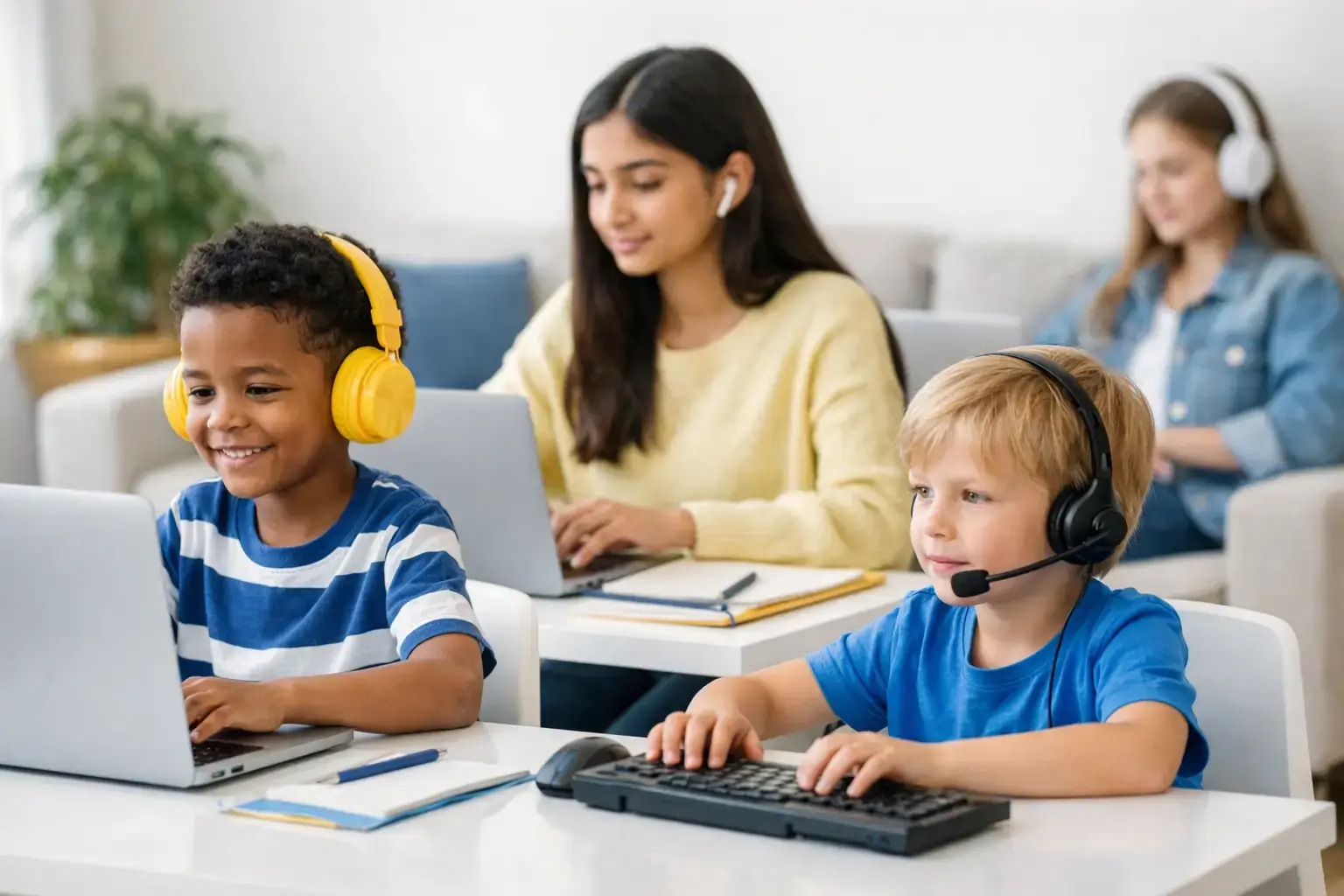
A child may be thriving academically yet exhausted by a long commute, anxious in a crowded classroom, or unable to balance school with elite sport, travelling or family life abroad. In those circumstances, asking is online school worth it is not really a question about screens. It is a question about whether education can be made more responsive without lowering expectations.
The answer is yes – but only when the online provision is a genuine school, not simply a collection of lessons, worksheets and recorded videos. A high-quality online education can offer exceptional flexibility, personal attention and academic momentum. It also requires structure, live human connection and active partnership with families.
Is online school worth it? It depends on the school
Online schooling is not one model. Some providers offer self-paced content with limited teacher contact. Others operate as full schools, following a recognised curriculum, teaching live each day, assessing progress properly and providing the pastoral care children need to feel known.
That distinction matters. Watching a video is not the same as being taught. Completing an online task is not the same as having a qualified teacher notice a misconception, ask a better question and adapt the lesson in the moment. For families considering online education, the quality of the educational relationship should be central to the decision.
A strong online school should provide a coherent programme across the school year, clear routines, regular feedback and a timetable that creates purpose in each day. Children should know where they need to be, what is expected and who to ask when work feels difficult. Parents, meanwhile, should have meaningful visibility of progress without being expected to become the teacher.
What children can gain from a well-run online school
The most compelling benefit is not flexibility alone. It is the opportunity to combine flexibility with continuity and ambition.
More attention in smaller classes
In a small online class, teachers can hear every child. They can identify when a pupil is ready to move ahead, when confidence is masking uncertainty, or when a quieter student has an insightful contribution to make. This is particularly valuable for children who have felt overlooked in larger settings, as well as those who need greater academic stretch.
Personalised learning does not mean lowering the bar or allowing pupils to work in isolation. It means teaching them from their genuine starting point, with clear next steps and high expectations. The result can be stronger confidence alongside stronger attainment.
A British education that travels with the family
For expatriate and globally mobile families, continuity is often the deciding factor. Moving between countries should not necessarily mean moving between curricula, languages of instruction and examination systems. An online British school can allow a child to continue with the National Curriculum for England while living overseas or relocating during the academic year.
This can also be valuable for families in the UK whose lifestyle does not sit neatly within a conventional timetable. Young athletes, performers and children with intensive commitments can protect their education without treating it as an afterthought. A live online school offers a dependable academic home while making room for serious pursuits beyond it.
Less time spent managing the school day
A school run, lengthy journey and busy site can take a surprising amount from a child’s day. Learning from home can return time for sleep, reading, family meals, training, hobbies and recovery. For some pupils, particularly those who find a conventional school environment overwhelming, removing these pressures can improve wellbeing and readiness to learn.
This should not be confused with an easier education. A good online school maintains deadlines, attendance expectations and academic challenge. The difference is that the day is designed around learning rather than the logistics of a physical campus.
Greater confidence and participation
Many children become more willing to contribute when they are in a calm, familiar environment and can communicate through a mix of voice, chat and shared work. Teachers can create clear turn-taking and ensure that discussion is not dominated by the loudest voices in the room.
Online learning is not the answer to every social difficulty, but it can give some pupils the space to rebuild confidence. With careful teaching and pastoral support, a child who has withdrawn from school can begin to participate, ask questions and enjoy learning again.
The trade-offs families should consider honestly
Online school is not automatically right for every child, every household or every provider. The strongest decision is an informed one.
Children need a suitable workspace, reliable internet and an adult at home who can help establish routines, especially in the early years. Younger pupils may need more practical support between lessons. Older pupils often need encouragement to manage their time, take breaks and step away from distractions. Independence is a skill to be developed, not an expectation to impose overnight.
Social development also deserves careful thought. A physical school offers spontaneous playground conversations, shared corridors and daily face-to-face contact. An online school must be intentional about community, offering tutor time, collaborative classwork, clubs, enrichment and opportunities for pupils to build friendships. Families should ask how a school creates belonging, not merely how it delivers lessons.
There is also a difference between flexibility and inconsistency. A timetable that is too loose can leave children disengaged; one that is overly rigid may fail to deliver the advantages families sought in the first place. The best model provides a regular live schedule while recognising that pupils have individual needs, different time zones and commitments outside school.
The questions that reveal quality
Before enrolling, look beyond attractive platforms and broad claims. Ask how much teaching is live each week and whether pupils are taught by fully qualified UK teachers. Clarify class sizes, curriculum coverage, assessment arrangements and the pathways available to recognised qualifications such as IGCSEs and A-Levels.
It is equally important to understand safeguarding and pastoral care. Who notices if a pupil is absent, unusually quiet or struggling? How often will parents receive updates? Is there a tutor or pastoral team that knows the child beyond their grades? Premium online education should feel personal, accountable and well organised.
Accreditation and school standards matter too. Families are placing a child’s academic future in the hands of an institution, not purchasing an app. Independent oversight, clear governance and alignment with recognised British standards offer important reassurance, particularly when a child may be studying online for several years.
At Sophia High School, pupils receive a full live-taught British education, with 20-25 hours of teaching each week, very small classes and qualified UK teachers. That high-contact approach reflects a simple principle: technology should support excellent teaching, never replace it.
Which children tend to benefit most?
Online school can be an excellent fit for self-motivated pupils, but it is not limited to them. Children who are academically ambitious, those who need more individual attention and those whose wellbeing has suffered in a traditional setting may all flourish with the right structure around them.
It can be particularly powerful for internationally based families seeking a stable British curriculum, home-educating parents who want professional teaching and assessment, and young people balancing education with high-level sport or performance. For these families, the question is often not whether flexibility is useful. It is whether that flexibility can come with proper academic rigour and human care.
The right online school answers both. It gives pupils access to expert teachers, purposeful peer relationships and recognised academic routes, while allowing family life to be lived with more freedom.
A school should expand a child’s future, not force a choice between achievement and the life they need to lead. If an online school can offer real teaching, clear standards, warm pastoral care and a community in which your child is seen, it may be far more than a practical alternative. It may be the setting in which they finally have room to excel.