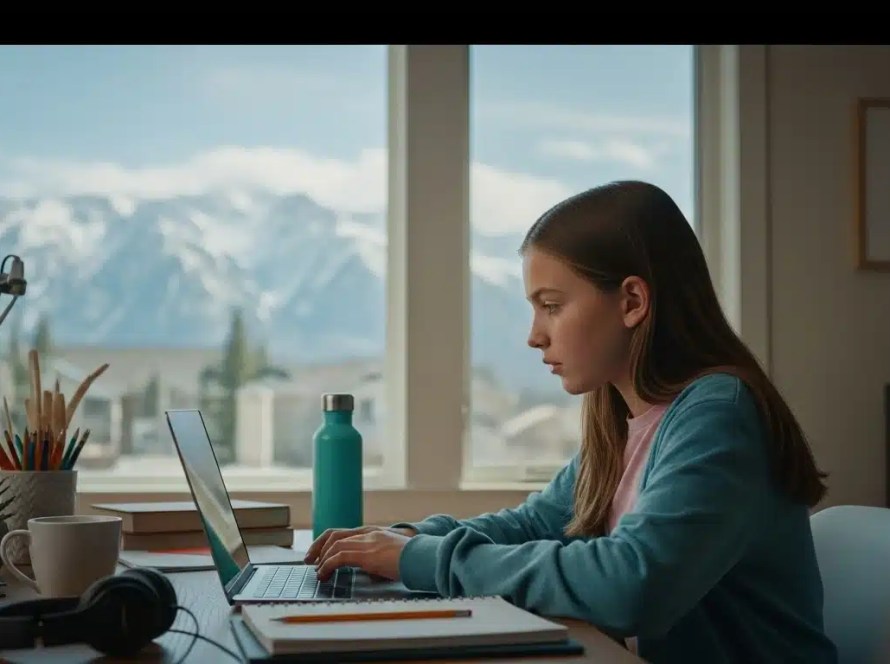
Online Secondary School England: What to Look For

25 Years Educational Leadership & Teaching Experience in British Independent & International Schools
TL;DR
- Choosing an online secondary school requires looking beyond mere convenience to evaluate standards, teaching quality, and pastoral care.
- Families increasingly choose online education due to flexibility, the need for smaller class sizes, and continuity with the National Curriculum for England.
- A premium online setting must prioritise live, expert teaching and interactive, small classes over pre-recorded material.
- Intentional pastoral care and academic rigour remain essential to support teenagers both emotionally and intellectually.
At secondary level, the difference between a child merely logging in and genuinely thriving is enormous. That is why choosing an online secondary school England families can rely on is not simply a question of convenience. It is a question of standards, teaching quality, relationships and whether online learning is being treated as real school or as a digital substitute.
For many families, the appeal is obvious. A strong online model can offer flexibility for travel, sport, health needs—with Department for Education data showing mental health is now the leading primary reason for elective home education at 16%—or family life without giving up academic ambition. But not all online schools are built to deliver that promise. Some provide a timetable, qualified teachers and meaningful pastoral care. Others offer little more than recorded content and independent tasks wrapped in the language of innovation.
Why families are considering online secondary school in England
The reasons are rarely casual. Some parents are looking for an alternative to overcrowded local provision, especially as DfE statistics show secondary class sizes have reached their highest levels in over two decades. Others are based overseas and want continuity with the National Curriculum for England, which remains the most popular English-medium curriculum globally according to ISC Research. Some need a school that can work around elite training schedules, medical circumstances or frequent relocation. Increasingly, families are also choosing online education because they want more visibility, more communication and a more personalised experience than many traditional settings can realistically provide.
That does not mean every child should move online. Secondary education is a formative stage, academically and socially. The right environment depends on temperament, maturity, family routines and the quality of the school itself. The strongest online schools recognise this and do not pretend that flexibility alone is enough.
What makes an online secondary school England families can trust
A credible online secondary school should look and feel like a school. That sounds obvious, but it is where many providers fall short. Real teaching matters. Live lessons matter. A structured timetable matters. So do expectations around attendance, behaviour, assessment and communication.
If a school relies heavily on pre-recorded material with minimal teacher contact, parents should ask difficult questions. Independent study has its place, especially as pupils progress through Key Stage 3 and Key Stage 4, but it cannot replace expert teaching. As the Education Endowment Foundation (EEF) highlights in its rapid evidence assessment, teaching quality—such as clear explanations and scaffolding—matters significantly more than the medium of delivery. Teenagers need explanation, challenge, feedback and accountability. They also need teachers who know them well enough to spot when confidence is dipping or effort is slipping.
Class size is another decisive factor. Small classes create the space for students to contribute, ask questions and be noticed, a factor the EEF notes can lead to up to three months' additional academic progress when managed effectively. In a crowded online room, it is far too easy for quieter pupils to disappear behind a switched-off camera and a completed worksheet. Premium online education should offer personal attention as standard, not as an optional extra.
Accreditation and standards are equally important. Families should look closely at whether a school is recognised, inspected and accountable to established British standards, such as the rigorous criteria set out in the Department for Education’s Online Education Accreditation Scheme (OEAS). This is particularly important for parents who want confidence that the education on offer is not simply British in marketing terms, but British in curriculum, expectations and outcomes.
Live teaching versus content delivery
This is often the clearest dividing line between serious online schools and low-touch platforms. Content can support learning, but content is not the same as teaching. A well-produced video may explain a concept. It cannot adapt in the moment, probe misunderstanding or draw out a hesitant student who knows more than they think.
Live teaching gives pupils routine and momentum. Ofsted’s own research into remote education found that regular live interactions are crucial for keeping pupils engaged and maintaining a strong classroom culture. It allows teachers to revisit difficult topics and stretch those who are ready to go further. It also gives parents reassurance. They know their child is not being left alone to manage a full academic load with only occasional marking and generic feedback.
In a strong secondary setting, live lessons should be frequent enough to create continuity across the week. For most families, this is one of the biggest indicators of quality. If a school offers only a handful of live sessions and expects pupils to self-teach the rest, that may suit some highly independent learners, but it is not the same as a fully taught school experience.
Academic rigour still matters online
Flexibility is attractive, but secondary education cannot become vague in the process. Families should expect a clear curriculum pathway through lower secondary and into recognised qualifications such as IGCSEs and A Levels where relevant. They should also expect specialist subject teaching, regular assessment and reporting that gives a genuine picture of progress.
Academic rigour online does not mean reproducing every habit of a physical school. It means setting high expectations and giving students the teaching and support to meet them. The best schools combine structure with adaptability. They know that a student training as an athlete, living abroad or managing an unconventional schedule may need flexibility, but not lowered standards.
This balance is where many parents become discerning. They are not looking for an easy option. They are looking for an excellent one.
Pastoral care is not optional at secondary age
Teenagers need more than lessons. They need belonging, encouragement and adults who notice changes in mood, motivation and confidence. In an online environment, pastoral care has to be intentional, aligning with the DfE’s Keeping Children Safe in Education (KCSIE) mandate that safeguarding and wellbeing must remain paramount across all educational settings. It will not happen by accident in a corridor or playground.
Families should ask how form time works, how staff monitor attendance and engagement, how concerns are escalated and how students build relationships with peers. A well-run online school has systems for safeguarding and communication, but it also has warmth. Students should feel known.
This is especially important for children joining from difficult school experiences. Some arrive after being overlooked in large classes. Others have lost confidence, become anxious—often manifesting as Emotionally Based School Avoidance (EBSA), a crisis that has surged post-pandemic according to parliamentary reports—or simply stopped feeling stretched. Online education can be transformative for these pupils, but only when the school combines academic ambition with careful human support.
Questions worth asking before you enrol
Parents do not need glossy promises. They need practical answers. How many hours of live teaching are provided each week? Are lessons taught by fully qualified UK teachers? What is the maximum class size? How does the timetable work across time zones? How are homework, feedback and reports managed? What happens if a pupil begins to struggle?
It is also wise to ask about the rhythm of the school day. Some online schools are highly structured, with regular registration, scheduled lessons and clear expectations. Others are far looser. Neither model is automatically right or wrong, but families should be honest about what their child needs. A bright teenager who lacks routine may not flourish in a setting that assumes exceptional self-discipline.
For internationally mobile families, continuity is often critical. A school following the National Curriculum for England can provide a stable academic home even when the child’s physical location changes. That consistency can be invaluable, especially during the secondary years when interruptions can quickly affect progress.
Who online secondary school works best for
Online secondary education can be an outstanding fit for students who are academically motivated, benefit from smaller classes or need flexibility without compromising standards. It can work particularly well for expatriate families, home-educating households seeking more structure, and young people balancing education with professional-level commitments in sport, performance or travel.
It can also suit pupils who have not thrived in traditional environments. Some do better when the social pressures of a large physical school are reduced. Others respond strongly to direct teacher attention and a calmer learning space.
That said, success still depends on the school and the home environment. Students need a suitable place to work, reliable technology and adults who are engaged with their education. The strongest schools make that partnership easy through clear communication and visible progress tracking.
For families seeking a premium British education online, schools such as Sophia High School stand out by offering what many others do not - full live teaching, very small classes, qualified UK teachers and standards aligned with British independent education and respected bodies like the Independent Schools Association (ISA) rather than a stripped-back digital model.
The real standard to judge by
When parents search for an online secondary school in England, they are often comparing websites that sound remarkably similar. Everyone claims flexibility. Everyone mentions personalised learning. The meaningful differences sit underneath those phrases.
Look for evidence of real teaching, real accountability and real care. Look for a school that is ambitious for your child and organised enough to deliver on that ambition. Secondary education shapes futures. It should not be entrusted to a platform that mistakes access to content for education.
The right school will give your child more than convenience. It will give them the confidence of being well taught, well known and properly prepared for whatever comes next.